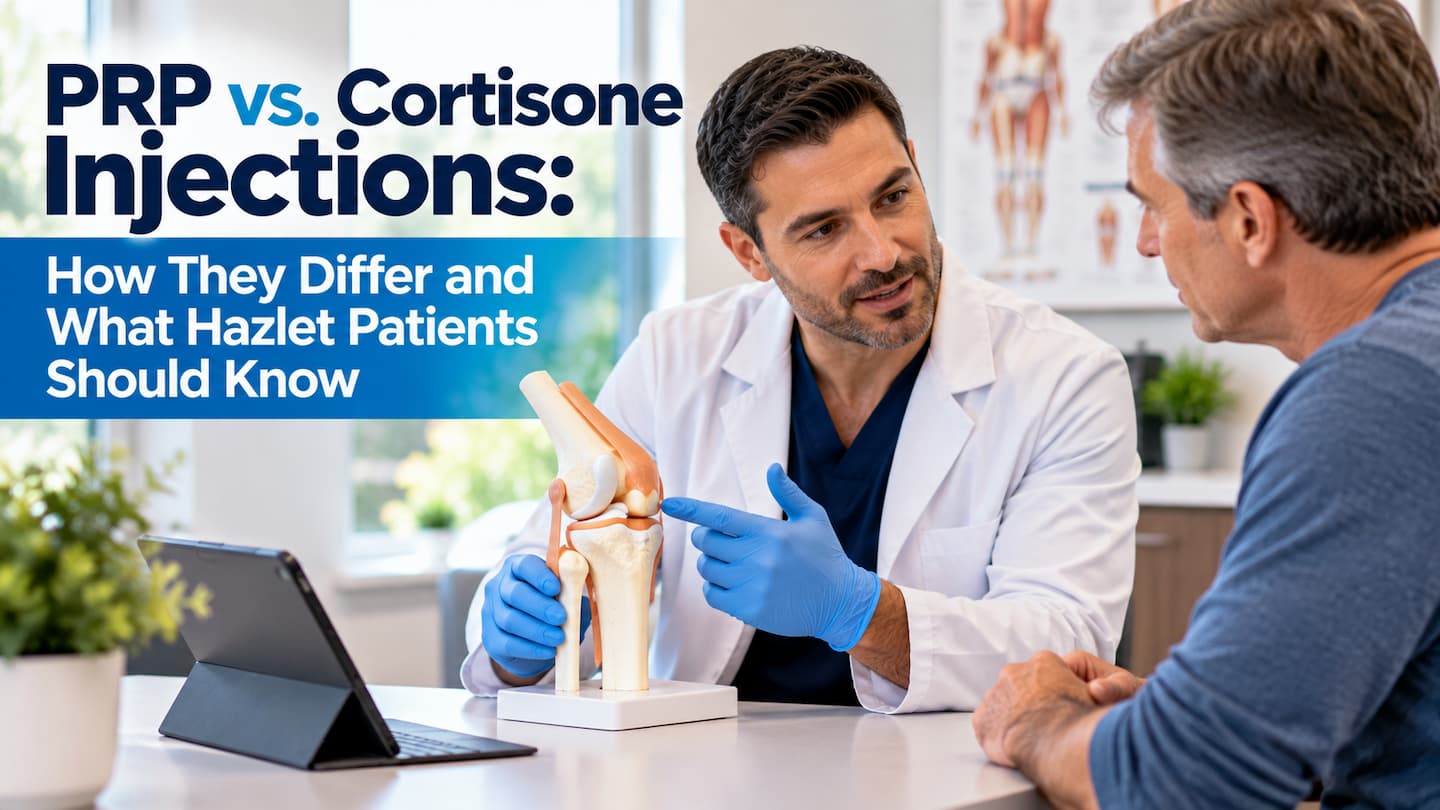
If a sore knee, shoulder or elbow is slowing you down, you may hear two injection options come up: a cortisone shot or platelet-rich plasma (PRP). Comparing PRP vs cortisone is not about finding a winner. The two work in different ways, have different evidence behind them, and fit different situations. This guide explains each one in plain terms so you can have a more informed conversation with a provider here in Hazlet or anywhere in Monmouth County.
What Is a Cortisone Shot?
A cortisone shot is an in-office injection that combines a corticosteroid (a strong anti-inflammatory medicine) with a local anesthetic such as lidocaine. According to the American Academy of Orthopaedic Surgeons (AAOS) OrthoInfo, the steroid reduces inflammation and pain, while the anesthetic covers the gap before the steroid starts working.
Cortisone shots are commonly used for arthritis, bursitis, carpal tunnel syndrome and some back pain, in joints like the shoulder, elbow, wrist, hip, knee and ankle. AAOS notes that relief is not immediate: it takes a few days to kick in, and pain may even get worse for 1 to 2 days first. When it helps, relief can last for several weeks.
What Is PRP (Platelet-Rich Plasma)?
PRP is made from your own blood. A small amount is drawn, then spun in a centrifuge to concentrate the platelets. AAOS describes PRP as plasma with many more platelets than are normally found in blood. Platelets carry growth factors involved in healing, and the concentrated sample is injected into the injured area, such as a tendon or joint.
AAOS is candid that it is not exactly clear how PRP works. Lab studies suggest the higher concentration of growth factors may support healing, but that is still being studied. You can read more about how our clinic approaches it on our PRP injections page.
One point that often causes confusion: PRP is not a stem cell treatment. It uses platelets and plasma from your own blood, not stem cells.
PRP vs Cortisone: How They Compare
Here is a general side-by-side look at PRP vs cortisone. Your own situation may differ, which is why an exam matters.
- What it is: Cortisone is a manufactured steroid medicine. PRP is a concentrate made from your own blood.
- Main goal: Cortisone aims to calm inflammation and pain. PRP is intended to support the body’s own healing response, though the exact mechanism is not fully understood.
- Timing: AAOS says cortisone takes a few days to kick in. With PRP, AAOS notes pain at the injection site may increase for the first week or two, and any benefit may take several weeks to appear.
- Tendons: AAOS says a cortisone shot should generally not be used for tendinitis because it may raise the risk of tendon rupture. By contrast, AAOS notes research suggests PRP may help some chronic tendon problems, especially tennis elbow.
- Repeat injections: Doctors often set a practical limit of 3 to 4 cortisone shots per year, and repeated shots may become less effective over time.
- Insurance: According to AAOS, few insurance plans cover PRP, even partially. Coverage for cortisone shots depends on your plan.
What the Research Says
Cortisone
AAOS describes cortisone shots as helping reduce pain in many joint conditions, with relief that can last several weeks. It also points out real limits. Repeated injections may contribute to cartilage breakdown and arthritis progression, and they can affect timing of later surgery: joint replacement in an injected joint should be delayed at least 3 months to lower infection risk.
PRP
The evidence for PRP is mixed and still developing. Based on the AAOS OrthoInfo PRP overview:
- Research suggests PRP may help some chronic tendon problems, especially tennis elbow. For other tendon conditions, it is unclear whether it works better than standard treatment.
- Evidence is growing for mild to moderate knee osteoarthritis.
- Studies have shown little or no benefit when PRP is used during rotator cuff repair or ACL surgery, and no significant benefit so far for broken bones.
- Overall, AAOS says research is still limited.
In short, when it comes to PRP vs cortisone, neither injection is a cure, and results vary from person to person.
Where Stem Cells Fit In: The FDA Position
Because PRP is often marketed alongside “regenerative” treatments, it is worth knowing what the U.S. Food and Drug Administration says. According to the FDA’s consumer information on regenerative medicine therapies, the only FDA-approved stem cell products in the United States are blood-forming stem cells from umbilical cord blood, approved for certain blood disorders. The FDA states that regenerative medicine products, including stem cell products, have not been approved to treat any orthopedic condition, such as knee or hip pain. If you are considering any regenerative product, ask whether it is FDA-approved for your condition, and if it is offered as part of a clinical trial.
Who May Be a Candidate for Each?
Only a hands-on evaluation can answer the PRP vs cortisone question for you, but some general patterns exist.
Cortisone may be considered when inflammation is a main driver of pain, such as bursitis or an arthritis flare, and when faster short-term relief is the goal. People with diabetes should know that a cortisone shot can temporarily raise blood sugar.
PRP may be discussed for some chronic tendon problems, like tennis elbow, or mild to moderate knee arthritis, especially for people who want to avoid or limit steroid shots and understand the evidence is still developing. If knee pain is your main concern, our article on knee pain treatment without surgery in New Jersey covers more options. For shoulder issues, see shoulder pain treatment without surgery.
Some patients also ask how PRP compares with other injection approaches. Our post on prolotherapy vs. stem cell injections explains another set of differences.
Side Effects and Red Flags
Both treatments involve a needle, so both carry some risk. MedlinePlus lists possible risks of steroid injections that include pain and bruising, swelling, skin irritation or discoloration, allergic reaction, infection, bleeding and nerve damage. For PRP, AAOS says the main risk is increased pain at the injection site, and the risk of infection, tissue damage or nerve injury appears similar to that of cortisone injections.
Seek medical care promptly if you notice signs of possible infection after any injection, including:
- Fever
- Increasing redness around the site
- Swelling or pain that is getting worse instead of better
A joint infection can be serious. If you have a high fever, feel very ill, or symptoms are worsening quickly, go to an emergency room or call 911.
Cost and Insurance
Insurance is often a deciding factor in the PRP vs cortisone decision. AAOS notes that few plans, including workers’ compensation, cover PRP, even partially, and recommends checking with your insurer before treatment. Ask your plan directly about any injection, and ask the clinic for a written cost estimate. For more background, read our post on regenerative therapy costs and insurance.
What to Expect at Your Visit
- Evaluation first: A review of your history, an exam, and any imaging you already have.
- The injection: For cortisone, the medicine is injected directly. For PRP, a blood draw and centrifuge step come first.
- Aftercare: MedlinePlus advises avoiding a lot of activity the day of a steroid shot and applying ice wrapped in a cloth for 15 to 20 minutes, 2 to 3 times a day. Follow the specific instructions your provider gives you for either treatment.
- Follow-up: Plan to check in so your provider can see how you are responding and adjust the plan.
Frequently Asked Questions
Is PRP better than cortisone?
Not in every case. Cortisone is used mainly for short-term relief of inflammation, while PRP has mixed evidence that is still developing. The better fit depends on your condition, health history and goals.
How long does a cortisone shot last?
According to AAOS, it takes a few days to start working, and relief can last for several weeks. Results vary.
Is PRP a stem cell treatment?
No. PRP is made from platelets and plasma in your own blood. The FDA states that no stem cell products are approved for orthopedic conditions.
Does insurance cover PRP?
Often not. AAOS reports that few insurance plans cover PRP, even partially, so check with your insurer first.
What should I watch for after an injection?
Some soreness is common. Watch for fever, increasing redness, swelling or worsening pain, and seek medical care promptly if they appear.
Talk With Stem Cell of NJ About Your Options
If you are weighing PRP vs cortisone or other non-surgical care, the team at Stem Cell of NJ (Airport Plaza Spine & Wellness) can review your history and explain the options, including their limits. Call (732) 264-2233, visit us at 1354 Route 36, Hazlet, NJ 07730, or contact us online to schedule a consultation.